
Goals (Personal goal, Course goal):
My course goal would be to make sure I think outside of the box and be more creative with my art. My personal goal would be to not procrastinate so that I can complete my artwork in time.
Principal and elements of art:
Principals of art:
- Line: Line is an element of art defined by a point moving in space.
- Shape: shape implies spatial form and is usually perceived as 2-dimensional.
- Color: colors all come from the three primaries and white and black. They have three properties, hue (the color itself), value, and intensity (the pure color is of the highest intensity, but we can lower the intensity by adding its complementary color).
- Value: value refers to relative lightness and darkness and is perceived in terms of varying levels of contrast.
- Form: form has depth, length, and width and resides in space. It is 3-dimensional.
- Texture: texture refers to the tactile qualities of a surface (actual) or to the visual representation of such surface qualities (implied).
- Space: space refers to the area in which art is organized. The element of positive (the space of the shape itself) and negative space (the space around the shape).
- Perspective: Perspective is representing a volume of space or a 3-dimensional object on a flat surface.
- Perspective: Perspective is representing a volume of space or a 3-dimensional object on a flat surface.
Elements of Art:
- Balance: Balance is the impression of equilibrium in a pictorial or sculptural composition. Balance is often referred to as symmetrical, asymmetrical, or radial.
- Contrast: the juxtaposition of different elements of design (ex. rough and smooth textures, dark and light values) in order to highlight their differences and/or create visual interest, or a focal point.
- Emphasis: Emphasis refers to the created center of interest, the place in an artwork where your eye first lands.
- Movement/Rhythm: movement or rhythm refers to the suggestion of motion through the use of various elements.
- Pattern: Pattern refers to the repetition or reoccurrence of a design element, exact or varied, which establishes a visual beat.
- Unity: Unity is achieved when the components of a work of art are perceived as harmonious, giving the work a sense of completion.
- Proportion/Scale: Proportion is the size relationship of parts to a whole and to one another. Scale refers to relating size to a constant, such as a human body.
- Proportion/Scale: Proportion is the size relationship of parts to a whole and to one another. Scale refers to relating size to a constant, such as a human body.
Color wheel:
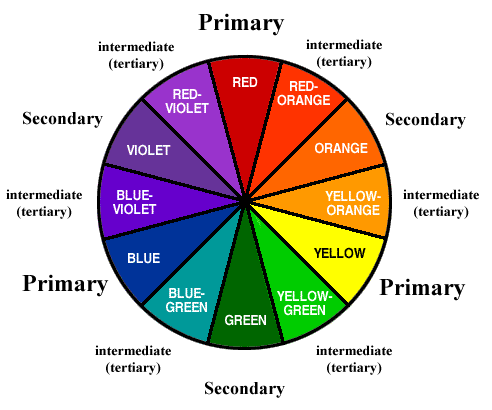
The primary colors are red, yellow, and blue. They are the base for all the other colors on the color wheel.
The secondary colors are in the middle of the primary colors (are made up of primary colors). They are orange, green, and violet.
The tertiary colors are made up of a primary and secondary color. They can also be called intermediate colors. Examples are red-orange, yellow-orange, yellow-green, blue-green, blue-violet, and red-violet.
Complementary colors are colors that are opposite each other on the color wheel (ex. red and green, blue and orange, and purple and yellow.) In a formative practice in 8th grade, we had to take two complementary colors and add a bit of the opposite color to both sides (add a bit of yellow to purple on the right side and add a bit of purple to yellow on the left side) and keep doing so in a line until we reached the middle. The color gray was formed. We concluded that mixing two complementary colors results in gray.
Complementary colors are colors that are opposite each other on the color wheel (ex. red and green, blue and orange, and purple and yellow.) In a formative practice in 8th grade, we had to take two complementary colors and add a bit of the opposite color to both sides (add a bit of yellow to purple on the right side and add a bit of purple to yellow on the left side) and keep doing so in a line until we reached the middle. The color gray was formed. We concluded that mixing two complementary colors results in gray.
Your definition of art:
My definition of art is something that allows us to express ourselves in a way that can't be put into words. it reflects our personality, mood, traits, and what we hold important in our lives. Art is boundless and even though we usually associate art with painting or drawing, art can be in many other forms such as music, dance, media, drama, etc.

No comments:
Post a Comment