

Monday, 7 September 2015

Friday, 28 August 2015
Mathematical Reflection 1
1. What are the common properties of all polygons?
All polygons should first of all be closed, and have at least 3 sides. It should have no sides intersecting and crossing, and the sides have to be straight. REGULAR polygons would have at least 3 equal length sides with all equal angles.
2. What does the measure in degrees tell you about an angle? What are some common benchmark angles?
The measure in degrees of an angle tell me if the angle is either acute (below 90 degrees), right (exactly 90 degrees), obtuse (above 90 degrees), or reflex (above 180 degrees). Some common benchmark angles are 30 (1/12 of 360), 45 (1/8 of 360), 90 (1/4 of 360), and 180 degrees (1/2 of 360). These are the fundamental angles that will cover a lot of possible angles, and help us reach as close as possible to the angle we want to locate.
 3. What strategies can be used to estimate angle measures? To deduce angle measures from given information? To find accurate measurement with tools?
Sometimes the benchmarks told above help us land exactly on the angle. It depends on what the angle is. If it is a multiple of 30, 45, 90 or 180, then we straight away know that we should use the benchmark which the angle is a multiple of. That would give the exact location of the angle. If the angle we are looking for isn't a multiple of any of the benchmark angles, then we would figure out which benchmark it is closest to. Usually the smaller benchmark angles like 30 degrees make finding the angle easier because the range the angle is between would be less than 90 degrees or 180 degrees, for example. To deduce the angle from the given information, we can apply our strategy of trying to find the benchmark closest to the angle we want to locate. Then, seeing how much farther the angle is from the benchmark range, we can make a logical conclusion of where the angle is located. There are also many tools that give the accurate measurement. For example, if you want to check your logical conclusion, you can use a protractor. Protractors will give the accurate measurement, and also help you understand how far apart your other strategies were from the real measurement. Angle rulers also help draw out the accurate angle.
 |
| This is a comparison showing what a polygon should and shouldn't look like |
2. What does the measure in degrees tell you about an angle? What are some common benchmark angles?
The measure in degrees of an angle tell me if the angle is either acute (below 90 degrees), right (exactly 90 degrees), obtuse (above 90 degrees), or reflex (above 180 degrees). Some common benchmark angles are 30 (1/12 of 360), 45 (1/8 of 360), 90 (1/4 of 360), and 180 degrees (1/2 of 360). These are the fundamental angles that will cover a lot of possible angles, and help us reach as close as possible to the angle we want to locate.
 3. What strategies can be used to estimate angle measures? To deduce angle measures from given information? To find accurate measurement with tools?
Sometimes the benchmarks told above help us land exactly on the angle. It depends on what the angle is. If it is a multiple of 30, 45, 90 or 180, then we straight away know that we should use the benchmark which the angle is a multiple of. That would give the exact location of the angle. If the angle we are looking for isn't a multiple of any of the benchmark angles, then we would figure out which benchmark it is closest to. Usually the smaller benchmark angles like 30 degrees make finding the angle easier because the range the angle is between would be less than 90 degrees or 180 degrees, for example. To deduce the angle from the given information, we can apply our strategy of trying to find the benchmark closest to the angle we want to locate. Then, seeing how much farther the angle is from the benchmark range, we can make a logical conclusion of where the angle is located. There are also many tools that give the accurate measurement. For example, if you want to check your logical conclusion, you can use a protractor. Protractors will give the accurate measurement, and also help you understand how far apart your other strategies were from the real measurement. Angle rulers also help draw out the accurate angle.
Thursday, 27 August 2015
My Reading Check-In
I think I have met expectations in my reading. First of all, in the first couple of weeks at school, I have developed my genre choices. I am more comfortable in trying something new, and I have weened off reading fantasy books. Examples of some different genres I read were Mystery (The Red Kayak by Pricilla Cummings) and Realistic Fiction (Wonder by RJ Palacio). I have even pushed my reading level further, and can now read higher level books with ease and comprehension. Some strategies I use for finding a good book are looking at the blurb, genre, length, and cover. I even read consistently everyday. If there is anything to work on, it would be keeping track of my reading using the reading log. I haven't updated my log as of yet, but I will try to be more conscientious in doing so. Otherwise, I am proud to say that I have improved drastically already, and can't wait to learn being more organised, committed, and interested in reading books!
Thursday, 20 August 2015


Do the Continents Fit?
 |
| I attempted to fit the continents electronically |
 |
| South America and Africa- two continents that fit the best together- glued in my notebook |
 |
| My group members and I tried fitting all the continents together by hand (Madagascar is missing) |
Sunday, 16 August 2015
Google Science Fair
I vote for Calvin Rieder who invented Passive Dual Purpose Condensers to Provide Potable Water.
I chose him because...
1. He gave me a detailed explanation on how the condensers work and the parts included. He did it in a simplified version which everybody could understand.
2. His invention seemed to be very useful, which could impact and change many people's lives. Overall he had a solution to a very common problem
Wednesday, 12 August 2015
My SS World Map- Countries I've Visited
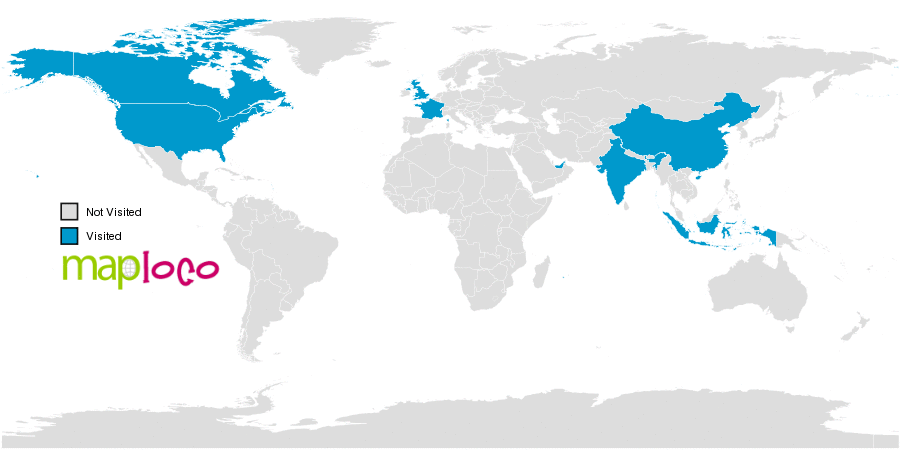
Create Your Own Visited Countries Map
a) I've visited 3 continents
b) I've visited 10 countries
Reflection: This map has helped me see all the places I've visited. I have noticed that North America has the most places visited, while Africa has none. I have also noticed that recently, I've been traveling in Asia. I have been to many different places and have gotten a good exposure to different cultures as well.
Subscribe to:
Posts (Atom)